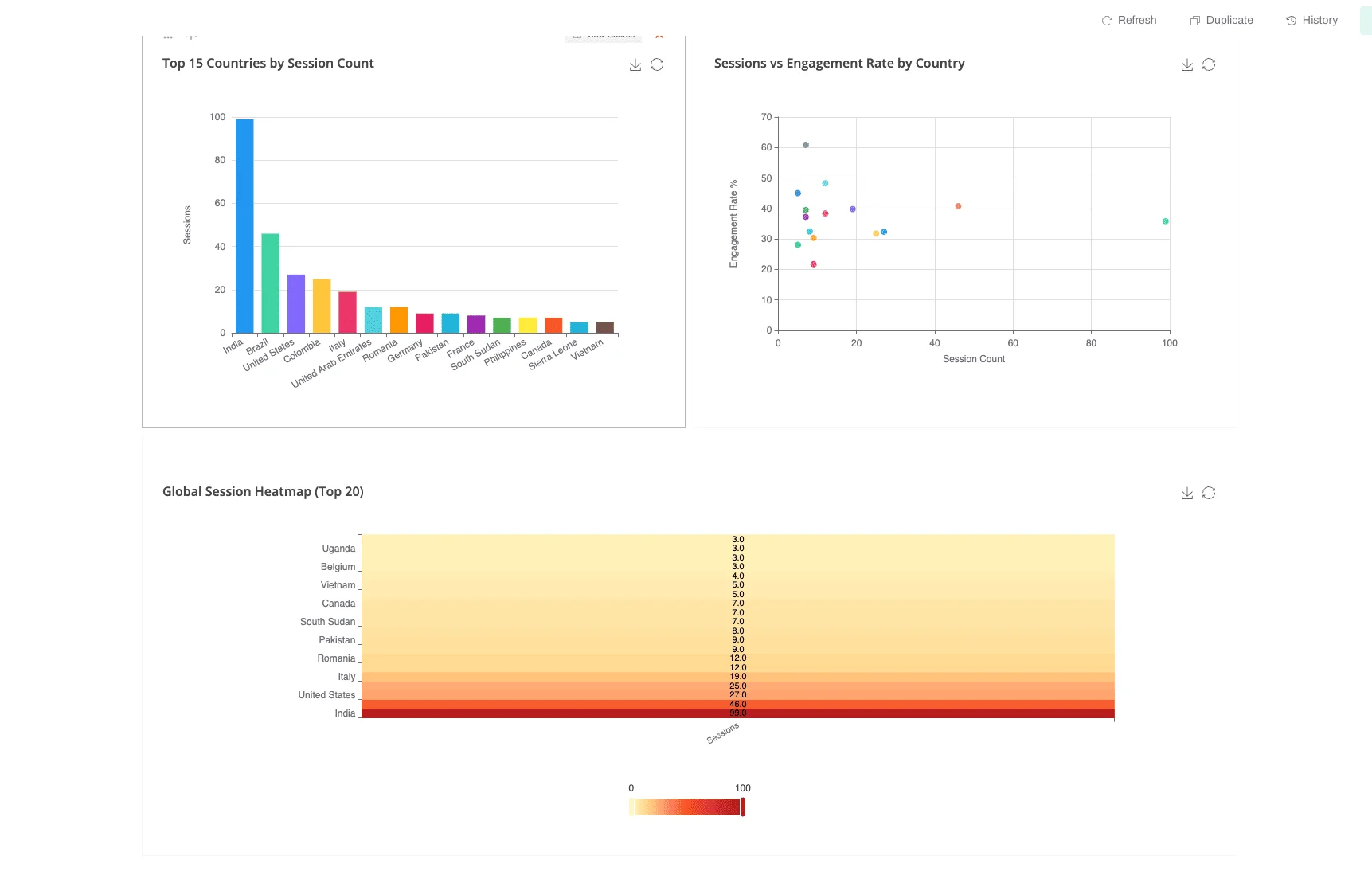
TL;DR: If you're asking "should we outsource data analytics or build in-house?" you're missing the option that makes both unnecessary for most teams: use an AI data analyst product. Anomaly AI handles the recurring analysis work that services firms charge $50K+ per year for — connect Excel, GA4, BigQuery, Snowflake, Google Sheets, or MySQL, then ask for the dashboard, report, scheduled update, or alert you need. Services still make sense for narrow cases.
The third option most teams don't consider
The "outsource vs build in-house" frame was the right question in 2020. You needed analytics. You couldn't do it yourself. The choice was hire a team (expensive, slow to ramp) or hire a consultancy (faster, less control). Both are real options, and both have real use cases that still exist in 2026.
But a third option has matured since then: AI data analyst products. Instead of paying a services firm to write SQL queries and build dashboards on your behalf, or hiring a full-time analyst to do the same, you connect your data to a platform that answers questions directly. The person who needs the answer asks the question. The AI writes the SQL. You verify the result. No intermediary, no ticket queue, no SOW.
This doesn't eliminate the services industry — regulated compliance dashboards, custom warehouse architecture, and one-time data migrations still need human expertise. But it eliminates the majority of the recurring analysis work that most teams hire services firms for: "pull the numbers," "build a report," "what happened to conversions last month?" That work is now a product problem, not a services problem.
To assess the product route, our comparison of AI tools for data analysis explains which tools suit files, spreadsheets and warehouse-based work.
Option 1: Outsource to a data analytics services firm
The outsourcing model: you hire an external consultancy or managed analytics provider to handle your analysis. They assign a team (or a fractional analyst), access your data, build dashboards and reports, and deliver insights on a regular cadence. Common models include project-based engagements, managed services retainers, and staff augmentation.
When outsourcing still makes sense
- Regulatory compliance dashboards: healthcare (HIPAA), financial services, government procurement — where the dashboards themselves are audited and must meet specific documentation standards. Services firms with industry-specific compliance experience earn their fee here.
- Custom warehouse architecture: if your company needs a data warehouse designed, built, and migrated from scratch, that's a one-time engineering project. Services firms that specialize in BigQuery, Snowflake, or Databricks architecture do this well.
- One-time data migration: moving from one platform to another (legacy ERP to cloud, on-prem SQL Server to Snowflake) is project work with a clear end date. Outsourcing makes sense when the skill isn't needed permanently.
- Advanced statistical modeling or ML: if the analysis requires custom machine-learning models, survival analysis, or econometric techniques beyond what an AI analyst covers, specialized consultants are the right call.
When outsourcing is overkill
- You need regular reports pulled from data you already have — GA4 exports, warehouse queries, spreadsheet analysis. This is recurring operational analysis, not a project.
- The question changes weekly. Services engagements work on defined scopes; ad-hoc questions blow the budget.
- You need answers today, not after a two-week onboarding period.
- The main deliverable is "tell me what the numbers say" rather than "build me a system."
Cost profile
Project-based analytics consulting typically runs $150–$300 per hour for mid-tier firms and $300–$500+ per hour for large consultancies. A managed analytics retainer for a mid-market company is commonly $5K–$15K per month, often with 6–12 month minimums. Staff augmentation for a senior data analyst runs $8K–$15K per month depending on geography and specialization. These are real costs for real work, but most of that work is answering recurring questions — work that a product can now handle.
Option 2: Build an in-house analytics team
The build model: you hire full-time data analysts, data engineers, and possibly a BI developer or analytics manager. They sit inside your organization, learn your domain, build and maintain your analytics infrastructure, and answer questions from the business on an ongoing basis.
When building in-house still makes sense
- Analytics is a core competency: if your product IS data (you're a data platform, an analytics vendor, a research firm), the analytics team is part of the product team. Outsourcing that doesn't make sense.
- Deep domain expertise is required: some industries need analysts who understand the domain so deeply that the ramp-up time for an outsourced team would erase the cost savings. Pharma, insurance underwriting, and algorithmic trading are common examples.
- You need institutional memory: a long-tenured analyst who has been watching the numbers for three years catches things that no new hire (or AI) would notice. If your analysis depends on historical context that lives in someone's head, that's an in-house function.
- Volume and velocity justify the headcount: if you have 50+ people requesting analysis daily, a dedicated internal team is justified. Below that threshold, you're paying for idle capacity.
When building in-house is overkill
- You need one or two analysts' worth of work but can't fill 40 hours a week.
- The analysis is broad but shallow — many different questions across many data sources, none requiring deep specialization.
- Your hiring timeline is 3–6 months and you need answers now.
- The team you'd build would spend most of their time on report-pulling rather than strategic analysis.
Cost profile
A senior data analyst costs $90K–$140K per year in total compensation (US). A data engineer costs $120K–$180K. An analytics manager or head of data is $150K–$220K. Add benefits, tools (BI licenses, warehouse compute, ETL tooling), and operational overhead, and a minimal two-person analytics function costs $250K–$400K per year. That's before you account for recruiting costs, ramp time, and the risk of turnover.
Option 3: Use an AI data analyst product — Anomaly AI
The third option: instead of hiring humans (internal or external) to translate your data questions into SQL and your SQL into charts, connect your data to Anomaly AI and let the person who has the question ask it directly. The AI writes the SQL, runs it, and returns the answer with the query visible underneath.
This isn't a replacement for all of Option 1 or Option 2. It's a replacement for the recurring analysis work that makes up the bulk of what services firms and in-house analysts actually spend their time on.
What Anomaly AI replaces
- "Pull the Q3 revenue by region" requests: the marketer, founder, or operator asks the question directly. No ticket, no wait, no SOW amendment.
- Weekly/monthly report generation: the person who reads the report generates it themselves, with logic anyone can inspect.
- Ad-hoc cross-source analysis: join GA4 data with a spreadsheet and a warehouse table in one question. Services firms charge change-order rates for this; the product handles it natively.
- Exploratory investigation: "Why did churn spike in March?" — ask follow-up questions iteratively until the pattern is clear, then share the conversation with the team. For a worked example, this customer churn analysis walkthrough checks a March spike against later reactivations before reporting it.
What Anomaly AI does not replace
- Custom warehouse architecture and data engineering — that's still a build-or-buy infrastructure decision.
- Regulatory compliance dashboards with audit trails and specific documentation standards.
- Advanced statistical modeling that requires custom ML pipelines.
- The institutional memory of a long-tenured analyst who understands why the numbers are what they are.
How it works
Connect your data sources once: BigQuery, Snowflake, MySQL, Excel (up to 1GB), Google Sheets, or GA4. Ask for the chart, table, dashboard, report, or alert you need. The typical path from signup to first real answer is under ten minutes.
Cost profile
Free $0 / Starter $16/month / Pro $25/month / Team $45/seat/month. Compare that to the services and in-house costs above. One Pro plan for a year ($300) costs less than a single month of a managed analytics retainer — and handles the ad-hoc question volume that would otherwise fill an analyst's week.
The 2026 decision framework: which option for which need
Most teams don't need to pick one option exclusively. The practical answer in 2026 is a stack:
| Need |
Best option |
Typical cost |
| Recurring analysis and ad-hoc questions |
Anomaly AI (product) |
$0–$300/month |
| Warehouse architecture or data migration |
Services firm (project-based) |
$50K–$200K one-time |
| Regulated compliance dashboards |
Services firm or in-house specialist |
$5K–$15K/month retainer |
| 50+ daily analysis requests |
In-house team + Anomaly AI as a force multiplier |
$250K+/year headcount + $300/month product |
| Custom ML / statistical modeling |
In-house data scientist or specialized consultancy |
$120K+/year or project-based |
The key insight: the services engagement and the in-house hire are still the right answer for infrastructure and compliance — the hard, specialized, one-time (or at least infrequent) problems. But the recurring "answer the business's questions" workload — which is what most teams actually spend their analytics budget on — is now a product problem. Start with the product; add services or headcount only when a specific need forces it.
How to tell which option you actually need
Ask yourself three questions:
- "Is the work recurring or one-time?" One-time architecture, migration, or compliance work → services or in-house project. Recurring questions about what the numbers say → Anomaly AI.
- "Does the work require deep domain or regulatory expertise?" If yes → human analyst or consultancy. If no → product.
- "How fast do we need the first answer?" If today → Anomaly AI (signup to first answer in under ten minutes). If next quarter → services engagement or in-house hire (realistic ramp times).
Most teams that land on this page searching "data analytics services" are actually in bucket #1 — they have data, they need recurring answers, and they assumed the only way to get there was to hire someone. The product option changes the math entirely.
The hybrid model that works best in 2026
The teams I've seen get the best results in 2026 run a simple hybrid: product for questions, people for strategy.
Anomaly AI handles the day-to-day analysis load — the ad-hoc questions, the weekly reports, the cross-source investigations that used to fill an analyst's Jira queue. This frees the in-house analysts (if you have them) to do the work that actually requires a human: interpreting context, building the narrative, making the recommendation, and owning the decision.
If you don't have in-house analysts, the product covers the analysis layer and you bring in a services firm only for the specific infrastructure or compliance projects that require specialized expertise. A $300/month Team plan plus a scoped $30K data-warehouse project is a more efficient spend than a $120K/year managed analytics retainer that bundles question-answering with infrastructure work.
Start with the product
If you're evaluating whether to outsource analytics or build in-house, try the third option first. It's free, it takes ten minutes, and it answers the question that most teams are actually trying to solve: "can we get reliable answers from our data without hiring someone to pull them?"
Try Anomaly AI free — Free $0 / Starter $16/month / Pro $25/month / Team $45/seat/month. Connect BigQuery, Snowflake, MySQL, Excel, Google Sheets, or GA4, then ask for the report or dashboard you need. If a services firm or an in-house hire is still the right call for your situation, the comparison above will help — but most teams won't need to get that far.