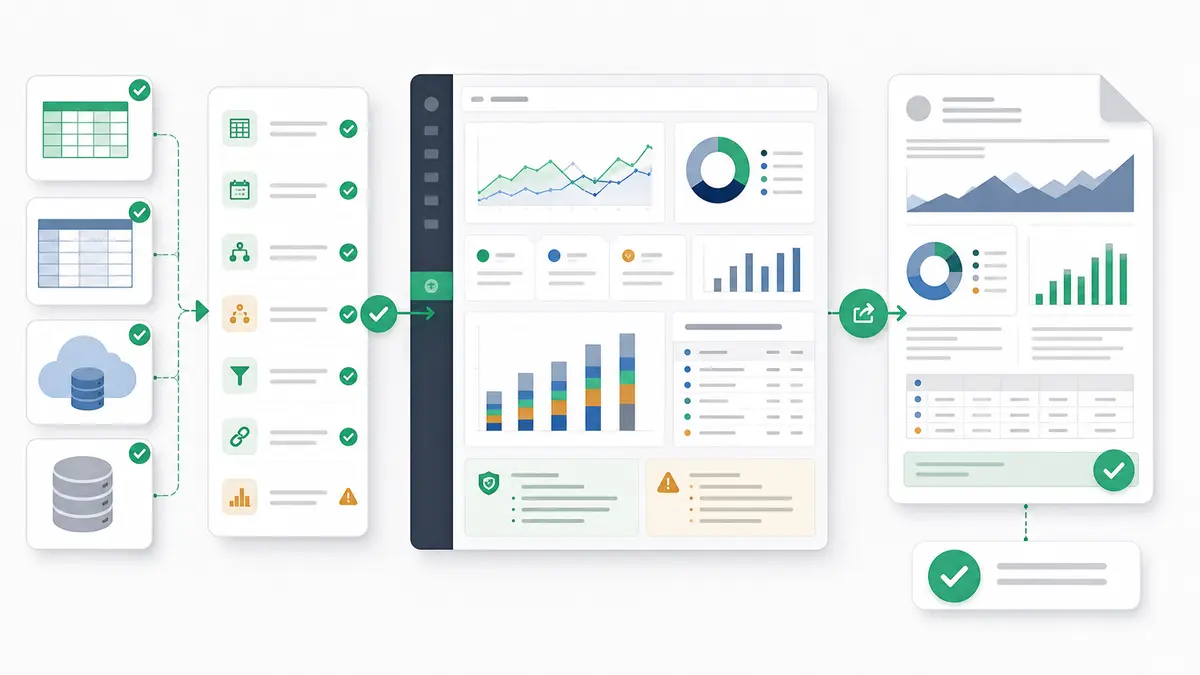
The AI data analysis landscape is undergoing its most significant transformation yet. According to Gartner's latest report, the data science and AI platforms (DSAI) subsegment grew by an unprecedented 38.6% in 2024, driven by explosive interest in AI data analytics, generative AI, and agentic AI technologies. The worldwide analytic platforms market is projected to reach $48.6 billion in 2025, with a five-year CAGR of 15.5%.
This isn't just incremental improvement—we're witnessing a fundamental shift from AI as a tool to AI as an autonomous analyst. For data teams drowning in spreadsheets, warehouse complexity, and stakeholder demands for instant insights, these trends represent both opportunity and necessary evolution. Here are the 10 critical AI data analysis trends that will define 2026.
If you're choosing software rather than following the trends, compare AI data analytics tools by their strengths, limitations and the teams they suit.
1. The Rise of Agentic AI for Data Analysis
The most transformative trend is the emergence of agentic AI for data analysis—autonomous systems that don't just assist with analysis, but independently plan, execute, and verify entire analytical workflows.
What Makes It Different
Unlike traditional AI data processing tools that require constant human direction, agentic AI systems operate with genuine autonomy. They inspect data schemas, identify quality issues, propose analytical approaches, execute transformations, generate insights, and even validate their own work—all without step-by-step human guidance.
Real-World Adoption: In December 2025, Snowflake announced a $200 million partnership with Anthropic specifically to drive agentic AI capabilities in enterprise data platforms. AWS launched new agentic AI features in AWS Transform targeting IT modernization and data processing at scale.
The Shift to Multi-Agent Systems
Enterprises are moving beyond single AI agents to coordinated "AI teams" where specialized agents handle distinct tasks—one for data quality, another for metric generation, another for visualization—collaborating like human analysts. According to recent industry analysis, this mirrors human teamwork patterns and enables handling of complex projects without constant tool-switching.
How Anomaly AI Implements This: Our platform uses agentic workflows where AI agents autonomously inspect your data schema, identify key metrics, clean data quality issues, and build dashboards and reports — but every output keeps the logic, source data, assumptions, calculations, and relevant SQL inspectable. You get autonomous efficiency without black-box uncertainty.
2. Natural Language to SQL Revolution
The barrier between business users and data is finally crumbling. Conversational analytics platforms now enable anyone to query complex databases using plain English, democratizing access to AI data analysis capabilities that once required SQL expertise.
Major Platform Launches
Snowflake Intelligence, built on Snowflake Cortex, allows users to explore and act on data by asking questions in natural language, completely eliminating the need for manual SQL writing or dashboard building. Looker's Conversational Analytics reached general availability in 2025, enabling instant answers to data questions through a conversational interface.
Kinetica embedded a native LLM directly into its analytics database for rapid, ad-hoc analysis on real-time structured data using natural language, while addressing critical concerns about data security and query accuracy.
Why This Matters for Data Teams
The SQL bottleneck has long prevented business teams from self-service analytics. With natural language interfaces, marketing managers can analyze campaign performance, sales leaders can track pipeline metrics, and finance teams can build reports—all without data team intervention. This doesn't replace analysts; it frees them from repetitive query requests to focus on strategic analysis.
Industry Impact: In August 2025, Salesforce acquired Waii, a company specializing in natural language processing for data management, signaling major enterprise commitment to conversational analytics.
3. Real-Time & Edge Analytics
The combination of IoT device proliferation and 5G network expansion is accelerating demand for analytics performed at the data source, not in distant cloud data centers. Real-time data analytics and edge computing are converging to enable instant decision-making.
The Speed Imperative
Traditional analytics workflows—collect data, transfer to warehouse, process, visualize—introduce latency measured in hours or days. For industries like manufacturing, healthcare, and financial services, that's too slow. Edge analytics processes data locally, reducing latency from hours to milliseconds and cutting bandwidth costs dramatically.
Real-World Applications
- Manufacturing: Predictive maintenance systems analyze equipment sensor data in real-time, preventing failures before they occur
- Healthcare: Patient monitoring devices process vital signs locally, alerting staff to critical changes instantly
- Retail: In-store cameras analyze customer behavior and inventory in real-time, optimizing layouts and stock levels
- Financial Services: Fraud detection systems analyze transaction patterns at the edge, blocking suspicious activity in milliseconds
The shift to edge analytics is driven by data analyzing AI models becoming lightweight enough to run on edge devices while maintaining accuracy—a technical shift that wasn't feasible even two years ago.
4. Automated Machine Learning (AutoML) Goes Mainstream
AutoML platforms are democratizing machine learning by automating the entire model development pipeline—from data preprocessing and feature engineering to model selection, hyperparameter tuning, and deployment. What once required dedicated data science teams can now be accomplished by analysts with domain expertise.
The Democratization Effect
Forrester projects that AI software will grow 50% faster than the overall software market, with spending doubling from $33 billion in 2021 to $64 billion by 2025. A significant driver is AutoML making machine learning accessible to non-specialists.
Enterprise Platforms Leading the Way
Google BigQuery ML allows data analysts to build and deploy machine learning models using straightforward SQL commands, eliminating the need for Python or specialized ML frameworks. Azure AutoML and AWS SageMaker Autopilot similarly abstract away complexity while maintaining enterprise-grade capabilities.
The Business Impact
Organizations no longer need to hire scarce (and expensive) data scientists for every predictive analytics use case. Business analysts who understand the domain can now build customer churn models, demand forecasts, and risk assessments using AutoML platforms—dramatically accelerating time-to-value for AI data analytics initiatives.
5. Data Mesh & Decentralized Analytics
The centralized data warehouse model—where a single platform team owns all data—is giving way to data mesh architecture, where domain teams own and serve their data as products.
Why Centralization Is Breaking Down
As data volumes explode and business agility demands increase, centralized data teams become bottlenecks. Every dashboard request, every new data source, every schema change flows through a overwhelmed platform team. Data mesh distributes ownership to cross-functional domain teams who understand their data best.
The Product Mindset
In data mesh architecture, each domain (marketing, sales, product, finance) treats their data as a product with clear SLAs, documentation, and quality guarantees. Other teams consume these data products through well-defined interfaces, not ad-hoc requests to the data team.
Scalability & Agility Benefits
According to data automation trend analysis, organizations adopting data mesh report faster time-to-insight, reduced platform team burnout, and better data quality—because domain experts maintain their own data rather than distant platform teams who lack context.
The Analytics Implication: AI data analysis tools must work across decentralized architectures, connecting to multiple domain data products rather than assuming a single unified warehouse. This is why connector-based platforms are gaining traction.
6. Predictive Analytics at Enterprise Scale
Predictive analytics is moving from specialized data science projects to embedded capabilities in everyday business workflows, powered by AI data processing that makes forecasting accessible at scale.
Explosive Market Growth
Precedence Research projects the global predictive analytics market will grow from $17.49 billion in 2025 to $100.20 billion by 2034—a compound annual growth rate of 21.40%. This isn't hype; it's organizations realizing predictive insights deliver measurable ROI.
Industry Adoption Leaders
The banking, financial services, and insurance (BFSI) sector led adoption in 2024, generating $3.99 billion in predictive analytics revenue. These organizations use data analysis AI for:
- Risk Management: Predicting loan defaults and market volatility
- Fraud Detection: Identifying suspicious patterns before losses occur
- Customer Insights: Forecasting churn and lifetime value
- Operational Efficiency: Optimizing staffing and resource allocation
The Cloud Deployment Shift
Cloud-based predictive analytics solutions are expected to reach $74.18 billion by 2032, reflecting enterprise preference for scalable, pay-as-you-go models over on-premise infrastructure. This aligns with the broader trend of AI data analytics moving to cloud platforms for flexibility and rapid deployment.
7. Governance, Security & Compliance-First AI
As AI agents gain autonomy, enterprises are demanding built-in governance, compliance, and security—not as afterthoughts, but as core architectural principles.
The Trust Requirement
Black-box AI systems that can't explain their reasoning or trace their data lineage are non-starters for regulated industries. According to strategic technology trend analysis, enterprises are designing AI agents to internalize compliance rules, understand regulatory boundaries, and enforce constraints automatically.
Audit-Ready Analytics
Modern AI data analysis platforms provide:
- Data Lineage: Complete traceability from dashboard metric to source data cell
- SQL Transparency: Every calculation shows the underlying query for verification
- Access Controls: Role-based permissions ensuring sensitive data stays protected
- Audit Logs: Complete history of who accessed what data when
- Compliance Automation: Built-in GDPR, SOC2, HIPAA controls
Why Anomaly AI Emphasizes This
Every chart and metric in Anomaly AI keeps the logic, source data, assumptions, calculations, and relevant SQL inspectable. This isn't just transparency — it's trust. When an executive asks "how did you calculate this?", you can show them the exact logic, verify it against source data, and demonstrate audit-ready rigor. No hallucinations, no guesswork — just verifiable insights.

AI analytics capabilities are shifting from standalone tools to native features embedded directly in CRM, ERP, and RPA platforms that businesses already use daily.
From Bolt-On to Built-In
The first wave of AI data analytics required organizations to adopt new platforms, migrate data, and train teams on unfamiliar interfaces. The second wave embeds AI directly into existing workflows—no context switching required.
Major Platform Moves
Salesforce Agentforce: Salesforce is embedding AI agents directly into its CRM platform, with better data integration and simpler licensing. Their acquisition strategy around Informatica signals commitment to native data analytics capabilities.
Microsoft Fabric Copilot: Microsoft is integrating AI-powered analytics across its entire data stack—from Excel to Power BI to Azure Synapse—creating a unified AI data processing experience.
SAP Analytics Cloud: SAP embedded predictive analytics directly into its ERP system, enabling finance teams to forecast without leaving their core workflows.
The User Experience Benefit
When analytics AI lives where users already work, adoption barriers collapse. Sales reps get pipeline insights in Salesforce, finance teams get forecasts in SAP, and marketers get campaign analytics in HubSpot—no separate login required, no data export needed.
9. Self-Service Analytics & Data Democratization
Low-code and no-code business intelligence platforms, powered by AI, are enabling employees across all departments to access and analyze data without technical expertise or data team dependency.
The Democratization Wave
By 2025, a significant majority of companies have adopted self-service BI platforms, according to industry trend analysis. This shift enhances internal agility and accelerates decision-making by putting insights directly in the hands of people who need them.
What "Self-Service" Really Means
True self-service AI data analytics means:
- No SQL Required: Natural language queries or visual query builders
- Automated Data Prep: AI handles cleaning, transformation, and joins
- Smart Visualizations: AI recommends chart types based on data characteristics
- Guided Analytics: Platforms suggest relevant metrics and comparisons
- Collaborative Sharing: Easy distribution of dashboards and reports
The Governance Balance
Democratization without governance leads to chaos—conflicting metrics, incorrect calculations, and data breaches. The best self-service platforms balance empowerment with guardrails: certified data sources, validated metric definitions, and role-based access controls ensure teams get freedom within safe boundaries.
10. AI Report Generators & Automated Insights
Beyond analyzing data, AI is now writing executive summaries, generating insights in natural language, and producing polished reports that previously required hours of analyst time.
From Data to Narrative
An AI report generator doesn't just create charts—it interprets trends, identifies anomalies, compares against benchmarks, and explains findings in business language. Marketing teams get campaign performance narratives, finance teams get variance explanations, and executives get KPI summaries—all generated automatically.
Market Demand Is Rising Fast
Searches for tools like "ai report generator" have grown steadily as organizations look for ways to transform raw data analyzing ai outputs into stakeholder-ready communications without hand-writing every summary.
Use Cases Driving Adoption
- Marketing Performance: Weekly campaign reports with ROI analysis and recommendations
- Financial Summaries: Monthly P&L narratives explaining variances and trends
- Executive Dashboards: KPI summaries with context and action items
- Sales Analytics: Pipeline health reports with win/loss pattern analysis
- Operational Metrics: Process efficiency reports identifying bottlenecks
The Quality Question
Early AI-generated reports suffered from generic insights and "hallucinated" conclusions. Modern systems ground their narratives in actual data, show supporting evidence, and flag uncertainty—making them trustworthy enough for executive consumption.
What This Means for Data Teams
These 10 trends aren't just technical shifts—they represent a fundamental redefinition of what data teams do and how they create value.
The Skill Evolution
Data professionals are transitioning from builders to orchestrators. Instead of writing every SQL query, they're designing AI workflows. Instead of creating every dashboard, they're validating AI-generated insights. Instead of answering every stakeholder question, they're enabling self-service while ensuring governance.
Strategic Implications
- Speed Becomes Table Stakes: Stakeholders expect insights in minutes, not days
- Scale Changes Economics: AI handling routine analysis means teams can tackle more strategic projects
- Trust Becomes Differentiator: In a world of AI-generated insights, transparent, auditable analytics win
- Integration Matters More: Tools must fit ecosystems, not require data migration
- Governance Is Non-Negotiable: Democratization without controls creates compliance nightmares
Avoiding the Hype Trap
Not every "AI-powered" tool delivers real value. Evaluate platforms on business outcomes, not buzzwords:
- Does it actually reduce time-to-insight or just add complexity?
- Can it handle your largest datasets or only demo-sized examples?
- Does it provide transparency and auditability or black-box results?
- Will it integrate with your existing stack or require data migration?
- Does it offer governance and security suitable for your industry?
How Anomaly AI Addresses These Trends
Anomaly AI was built from the ground up to align with these emerging trends, offering an AI data analyst agent for large datasets that combines autonomy with transparency.
Trend Alignment
Agentic AI Workflows (Trend #1): Our AI agents autonomously inspect schemas, identify key metrics, clean data quality issues, and build dashboards and reports — but every output keeps the logic and source data verifiable. You get autonomous efficiency without black-box uncertainty.
Multi-Source Integration (Trend #8): Connect Excel files, BigQuery, GA4, MySQL, Snowflake, and Google Sheets—no data migration required. Our connector approach fits data mesh architectures and decentralized analytics.
Real-Time Processing (Trend #3): Direct database connectors enable analysis on live data without ETL delays. Query BigQuery or Snowflake in real-time and get insights on current state, not yesterday's snapshot.
Governance & Transparency (Trend #7): Every dashboard and report keeps its logic, source data, assumptions, calculations, and relevant SQL inspectable. Click into the output to inspect exact logic, verify against source data, and maintain audit-ready rigor. No hallucinations, no guesswork — just verifiable insights.
Large Dataset Handling (Trend #4 & #6): Built for datasets with millions of rows, our platform uses optimized SQL execution rather than in-memory processing. Handle enterprise-scale data without performance degradation.
Automated Insights (Trend #10): AI agents don't just create dashboards—they surface anomalies, identify trends, and highlight what matters most in your data, saving hours of manual exploration.
Our Differentiators
- SQL-Backed Transparency: Unlike black-box AI tools, every insight is traceable to source data
- No Data Migration: Connect directly to existing data sources—Excel, warehouses, databases, analytics platforms
- Agentic but Auditable: AI operates autonomously while maintaining complete transparency
- Built for Scale: Handle millions of rows without the performance issues that plague spreadsheet-based tools
- Ecosystem Integration: Work with your existing stack, not replace it
Explore Our Connectors: BigQuery | Excel | GA4 | MySQL | Snowflake | Get Started →
Looking Ahead: 2026 and Beyond
The convergence of these 10 trends points to a clear future: AI data analysis is evolving from a tool you use to an analyst you collaborate with. The distinction between "using AI for analytics" and "AI performing analytics" is collapsing.
What to Expect Next
- Further Autonomy: AI agents will handle end-to-end workflows with minimal human intervention
- Deeper Integration: Analytics AI will be inseparable from business applications
- Universal Natural Language: Conversational interfaces will become standard, not premium features
- Predictive by Default: Every dashboard will include forecasts and trend projections automatically
- Governance Automation: Compliance and security will be AI-enforced, not manually maintained
The Human Role Evolves
Data professionals won't be replaced—they'll be elevated. The long-standing pattern where analysts spend most of their time on data wrangling and only a fraction on actual strategy is starting to flip as AI takes over the mechanical work. Analysts become strategic advisors, focusing on business context, ethical considerations, and decisions that require human judgment while AI handles the plumbing.
The Anomaly AI Vision
We're building toward a future where AI data analytics means having a tireless, transparent analyst who:
- Understands your data sources and how they connect
- Proactively surfaces insights you didn't think to ask for
- Explains its reasoning in a way you can inspect
- Scales to handle enterprise datasets without breaking
- Respects governance and compliance requirements automatically
That's not science fiction—it's the logical endpoint of the trends we're seeing today.
Ready to Experience the Future of AI Data Analytics?
See the trends in a real product: Anomaly AI turns large datasets into dashboards, reports, scheduled updates, and traceable analysis workflows with connector coverage.
Try Anomaly AI free, then upgrade to Starter $16/month, Pro $25/month, or Team $45/seat/month when you need more scale.
Connect your data sources in minutes and let AI agents handle the analysis while maintaining complete transparency and auditability. No migration required, no black boxes, no hallucinations—just trustworthy insights from your actual data.
Related Reading:
Follow us on LinkedIn for updates on AI data analysis trends and product developments.